Powering the Future: Why Ghana Must Turn Shopping Malls into Engines of Urban Energy Reform

From “Dumsor” to Distributed Power: A Quiet Revolution in Ghana’s Cities
Ghana’s rapidly expanding urban centres—particularly Accra and Kumasi—are placing unprecedented strain on national infrastructure, with the energy sector under the greatest pressure. As demand surges and urban lifestyles grow more energy-intensive, grid instability and persistent outages (“dumsor”) continue to disrupt daily life and economic productivity. Yet, amid these systemic challenges, an unlikely leader is emerging: the modern shopping mall.
Far from being mere retail spaces, malls in Ghana are increasingly adopting energy autonomy—the ability to generate, store, and manage electricity independently through solar power, battery storage, and smart energy systems. This transition is not just about keeping lights on during outages. It represents a fundamental shift toward decentralized, resilient urban energy systems. By ensuring uninterrupted operations—lighting, cooling, and business continuity—energy-autonomous malls are doing what the national grid often cannot: delivering reliability. In doing so, they are becoming critical actors in shaping more stable, functional, and resilient cities.
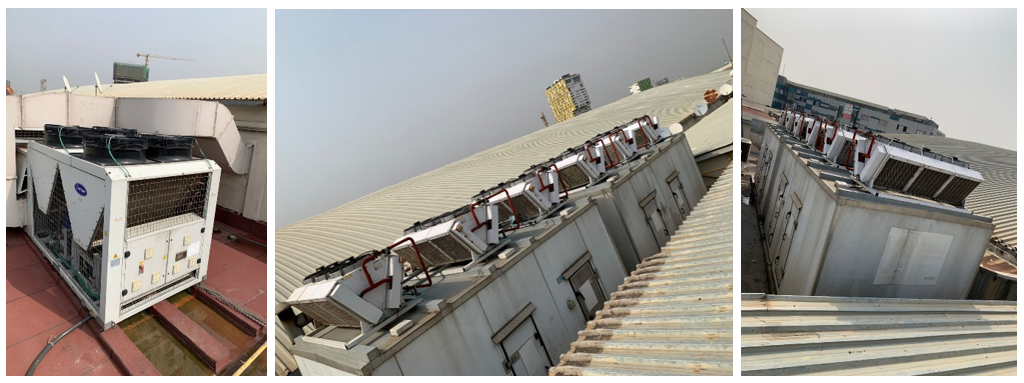
Heating, Ventilation and Air-conditioning (HVAC) Equipment at the Accra Mall in Ghana
Cooling the City: Energy Autonomy as a Public Health and Comfort Imperative
In Ghana’s hot and humid climate, thermal comfort is not a luxury, it is essential for wellbeing, productivity, and public health. Recent research on malls in Accra and Kumasi reveals stark differences:
- High-autonomy malls recorded minimal indoor temperature increases during outages—averaging just 1.5°C
- Low-autonomy malls experienced spikes of up to 5.8°C, with prolonged recovery times
The difference lies in integrated systems: solar power, battery backups, and automated HVAC technologies that respond instantly to disruptions. These temperature variations are not trivial. They tick on other indicators including :
- Customer experience and dwell time
- Worker productivity and health
- Overall urban livability
Therefore, thermal comfort must be recognized as a core urban resilience metric, and energy systems in commercial buildings should be regulated accordingly.
Confidence is Power: Energy Reliability can Drive Economic Stability
Tenant satisfaction is the backbone of mall performance—and by extension, local economic vitality. Studies have shown that high-autonomy malls had a mean of 4.35 out of 5.0 satisfaction score from their customers while the low-autonomy malls scored 2.73 out of 5.0. This glaring gap reflects more than comfort – it signals a wholistic customer confidence in infrastructure, management, and long-term viability. This ultimately translates in more business investments, longer-term leases and overall positive impact on local economy. Hence, reliable energy is not just infrastructure—it is a driver of private sector confidence and urban economic growth.
Malls as Living Laboratories for Green Urban Development
Energy-autonomous malls align directly with Ghana’s national ambitions for renewable energy and sustainable development. Through adoption green energy solutions such as Solar photovoltaic (PV) systems, Smart HVAC technologies and Advanced energy management software, the buildings reduce dependence on fossil fuels, lower emissions and improve operational efficiency.
They serve as proof-of-concept for scalable green infrastructure. Their visibility and success influence developers across sectors, accelerating adoption of sustainable technologies.
So, what is holding back the adoption scale-up of energy autonomy?
Despite the demonstrated clear benefits, a host of barriers stand in the way of scale-up. These include high initial capital costs, limited access to green financing and lack of regulatory incentives. If these barriers are not broken, energy autonomy risks remaining a niche innovation rather than a national standard.
To break the barriers and foster widespread energy autonomy, there is need to create an enabling policy environment and support for energy autonomy initiatives. These include
- Establishing minimum energy performance standards for commercial buildings
- Introducing tax incentives for green-certified infrastructure
- Expanding accessible green financing mechanisms
Such would unlock widespread adoption, transforming not just malls but offices, hospitals, and residential developments.
Aligning with Global Sustainability Goals: From Local Innovation to Global Leadership
Ghana’s investment in energy-autonomous infrastructure directly supports several UN Sustainable Development Goals depicted below
By improving energy access, reducing emissions, and strengthening resilience, Ghana is positioning itself as a model for other African cities and developing economies.
Ghana’s urban future depends on how energy is delivered: not just reliably, but fairly, sustainably, and resiliently.
Energy-autonomous malls demonstrate what is possible:
- Stable indoor environments during outages
- High tenant confidence and economic stability
- Reduced environmental impact
The malls are not just buildings; they are blueprints for the next generation of African cities. Fair power does more than keep the lights on—it builds stronger, healthier, and more resilient urban communities.
Biography
Dr. Williams Miller Appau is a lecturer in the Department of Real Estate at the University of Business and Integrated Development Studies, Ghana. A recipient of the ARUA–Mastercard Foundation Fellowship, and a postdoctoral researcher at the Centre for Urbanization and Habitable Cities, UNILAG, with expertise in Sustainable Real Estate and Management. More…

