From Evidence to Action: ARUA Global Dialogue Calls for Action on Food Loss and Waste

An estimated 13% of food produced globally is lost after harvest and before reaching retail, while another 19% (about 1.05 billion) of food available to consumers is wasted at retail, food service and household levels. At the same time, millions continue to experience hunger and billions cannot afford a healthy diet. In addition, food loss and waste contributes around 10% of global greenhouse-gas emissions.
Against this backdrop, the African Research Universities Alliance (ARUA) and the ARUA Centre of Excellence for Sustainable Food Systems (ARUA-SFS) convened the ARUA Global Dialogue on Food Loss and Waste to mark the International Day of Awareness of Food Loss and Waste (IDAFLW) 2026.
The dialogue was the second in ARUA’s CoE-led Webinar Series, bringing together expertise from three ARUA CoEs at the intersection of FLW – Sustainable Food Systems (SFS), Climate & Development, and the African Centre of Excellence for Inequality Research (ACEIR).
Established by the United Nations General Assembly in 2019, IDAFLW seeks not only to raise awareness, but importantly to mobilize action to reduce food loss and waste—an ambition also reflected in SDG Target 12.3.
What do we know and what are we doing enough with what we know?
Held under the theme “From Evidence to Action: The Role of Research and Partnerships in Tackling Food Loss and Waste,” the dialogue centred on one question: What will it take to move from evidence to action?
While evidence, technologies and promising solutions exist, many still struggle to move from research and pilots to adoption, implementation and scale.
Keynote speaker Prof. Lindiwe Majele Sibanda, member of Champions 12.3, set a strong reference point through the Target–Measure–Act approach: set clear ambitions, measure the problem and act on the evidence.
Drawing on examples from countries, businesses and partnerships around the world, she demonstrated that meaningful reductions in food loss and waste are possible when evidence is backed by policy, innovation, investment and accountability. Her challenge to African universities and especially the ARUA Universities was compelling:
| Universities can become living laboratories where food-system problems are studied, solutions tested and evidence translated into real-world decisions. |
For ARUA, this presents an opportunity to generate stronger “ARUA evidence” on food loss and waste and nurture champions who can help translate evidence into action.
Understanding food loss and waste from multiple perspectives
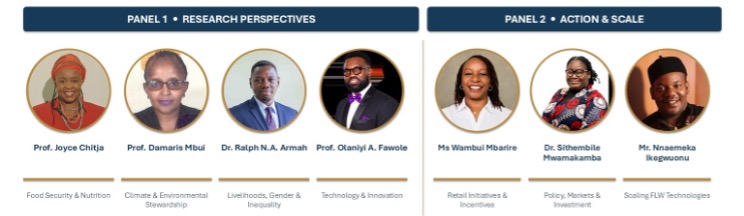
The first panel of experts examined food loss and waste through four interconnected lenses: food security and nutrition; environmental stewardship and climate change; livelihoods, gender and inequalities; technology and innovation.
The second panel shifted the conversation to implementation and scale, bringing perspectives from the private sector, policy, markets and investment, and practitioners scaling food loss reduction technologies.
Several messages came from the discussions:
- Evidence matters, but evidence alone does not create impact
- Promising solutions exist, but adoption and scaling remain challenging
- Financing, enabling policies and markets are critical
- No single actor can tackle food loss and waste alone, partnerships and collaborations are key
Participants also had their say through interactive Zoom polls. Most participants perceived that more than 40% of food produced for human consumption is lost or wasted along the food supply chain. When asked what the most urgent action needed to accelerate food loss and waste reduction in Africa, the participants prioritized scaling appropriate technologies and infrastructure. This reinforced the need to move proven solutions beyond research and pilots to adoption and scale.
From dialogue to action
Prof. Sibanda left participants with a fitting challenge:
The next step is not another discussion. It is one concrete commitment we can measure.
ARUA will build on the dialogue to explore opportunities for research, institutional action and partnerships across its network, including generating stronger ARUA evidence on food loss and waste. The deliberations will also inform a white paper capturing the key insights and priority actions emerging from the dialogue.
Watch the Webinar on YouTube:


