Africa has the sun. But are we harnessing it safely?

New research is unlocking safer, lead-free materials to power Africa’s clean energy future
Africa gets more sunlight than almost any place on Earth, enough to power the whole continent many times over. Yet millions of people still lack reliable electricity. From rural homes to schools and hospitals, getting energy is a daily struggle. Solar power seems like the clear answer, and it is growing fast. But as more panels are installed, an important question is often ignored: what are solar panels made of, and are those materials safe?
The hidden problem with solar materials
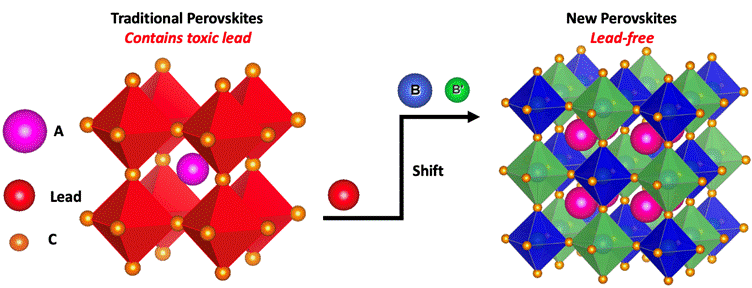
Many of today’s top solar panels use perovskite materials, special compounds that are highly efficient at converting sunlight into electricity. They are exciting because they can make solar energy cheaper and better. However, there is a major concern: many of the best-performing perovskites contain lead, a harmful heavy metal. If solar panels are improperly disposed of, lead can leak into soil and water. This can harm crops, pollute drinking water, and cause long-term health problems. For communities where solar panels are installed near homes, schools, and farms, this is a serious issue. It is a risk that must be taken seriously as solar use grows.
Are there safer alternatives?
New research is finding safer alternatives to these materials. Using advanced computer simulations based on the laws of physics, we are designing lead-free materials that could replace traditional perovskites (https://doi.org/10.1016/j.cocom.2026.e01305). This approach allows us to test how materials behave, how well they absorb sunlight, how stable they are, and how efficiently they can generate electricity, without first creating them in a laboratory. In simple terms, it is like running thousands of experiments in a virtual lab before selecting the most promising candidates to test in real life. This work has already identified promising lead-free materials for solar and other energy technologies, offering a safer path forward.
Why this matters for Africa
This method is especially important for Africa. Building and running advanced labs is expensive and time-consuming. But computer-based research opens a different way. With the right training and access to computers, researchers can make important discoveries without waiting for costly equipment. This creates an opportunity to skip traditional barriers and actively participate in global scientific innovation. At the same time, making safer solar materials is about more than science; it is about people. Communities need energy solutions they can trust. Solar technologies should not only be efficient and affordable but also safe for the places where they are used.
A transformational shift: from technology imports to investing in local solutions
The future of energy on the continent cannot rely entirely on imported technologies designed for different conditions and priorities. It must be shaped by local expertise, local research, and local needs.
This will require targeted investments in the following areas:
- Building capacity in computational science and renewable energy technologies – in tertiary institutions
- Supporting early-career researchers to drive innovation
- Building capacity for research translation – from the labs to policy makers and end users including the industry
Locally generated research outputs are better contextualized and more likely to address real challenges and lead to real impact.
A call to action
Africa has immense solar potential. Harnessing it safely requires thoughtful choices about the materials we use and the technologies we adopt. Governments should invest in local research capacity. Universities should integrate computational science into their programmes. Funders should support African-led innovation. And policymakers should rely on locally generated evidence when selecting energy technologies. The transition to clean energy is not just about generating power; it is about doing so responsibly, sustainably, and safely.
Conclusion
Africa has the sun. With adequate, targeted investment in science, backed by an enabling policy environment, researchers can also develop safer, smarter materials to harness it, ensuring that the clean energy future we build today does not create new risks tomorrow.
Author Bio
Dr. Mwende Mbilo is a physicist specializing in solar energy technologies. She is a postdoctoral researcher at the University of Pretoria, where she works under the mentorship of Dr. Edwin Mapasha, hosted by the ARUA Centre of Excellence in Materials, Energy and Nanotechnology (CoE-MEN), and funded by the ARUA/Mastercard Early Career Research Fellowship. More…


