
ARUA Pilot Mid Career Research Fellowships 2026–2027
Supported by the Andrew Carnegie Foundation
The African Research Universities Alliance (ARUA), with support from the Andrew Carnegie Foundation (formerly Carnegie Corporation of New York), invites applications for its pilot Mid‑Career Research Fellowships for 2026–2027. The programme will support up to ten (10) mid‑career academics to undertake six‑month, research‑intensive sabbatical placements at selected research-intensive institutions including the ARUA’s thirteen (13) Centres of Excellence (CoEs) and the twenty-two (22) Clusters of Research Excellence (CoREs) between September 2026 and August 2028.
The fellowship is intended to strengthen research leadership, deepen collaborative and interdisciplinary work, and generate high‑impact scholarly and policy‑relevant outputs that advance ARUA’s 2022–2027 Strategic Plan.
The fellowship targets academics at Associate Professor level with a proven track record of post-PhD (or equivalent) scholarly experience in full time employment at an ARUA university. The beneficiaries should have a dedicated six-month sabbatical period away from routine institutional duties, enabling intensive collaboration with leading experts at ARUA CoEs or Africa-Europe CoREs. Each CoE or CoRE is expected to host fellows from countries other than their home country to promote cross-institutional knowledge exchange, interdisciplinary innovation, and mentorship of emerging scholars.
1.1 About ARUA
ARUA is a network of 23 leading universities in Africa, established to make African researchers and institutions globally competitive while contributing to the continent’s socio‑economic transformation through research and innovation. ARUA pursues this mission through four core pillars: (i) collaborative research, (ii) expanded and improved PhD training and support, (iii) strengthened research management, and (iv) research advocacy.
Thirteen interdisciplinary CoEs (Centres of Excellence – ARUA) and 22 Africa–Europe CoREs (Africa-Europe Clusters of Research Excellence – Africa-Europe CoRE) anchor ARUA’s
research and graduate training portfolio across priority themes including water, energy, climate and development, non‑communicable diseases, sustainable food systems, governance, inequality, migration, urbanisation and peace.
1.2 About the Andrew Carnergie Foundation (formerly Carnegie Corporation of New York)
The Andrew Carnegie Foundation, originally established as Carnegie Corporation of New York, is a philanthropic organization founded in 1911 by Andrew Carnegie for the advancement and diffusion of knowledge and understanding. Its programme on Higher Education and Research in Africa supports initiatives that strengthen academic training, retention and research productivity of scholars in sub‑Saharan Africa, to which this fellowship directly contributes.
2.1. Background
The Mid‑Career Research Fellowship builds on ARUA’s Early‑Career Researcher Fellowships by addressing a critical gap in opportunities for mid‑career academics. Mid‑career scholars are often required to shoulder extensive teaching, supervision and administrative duties at the very time they are poised to consolidate their research leadership and mentorship roles.
By providing protected time, structured financial and institutional support, and access to ARUA CoEs and CoREs, the fellowship will:
- Enable mid‑career researchers to complete substantial research outputs of continental and global relevance.
- Strengthen intra‑African and Africa–Europe research networks, including joint supervision, cross‑institutional teams and collaborative grant applications.
- Expand the pool of experienced supervisors and mentors able to support ARUA’s collaborative doctoral programmes and early‑career fellowships.
- Contribute to ARUA’s data‑driven advocacy and strategic ambition to significantly increase Africa’s share of global cutting‑edge research output and the number of African universities among the top global institutions.
The initiative is directly aligned with ARUA’s Strategic Plan (2022–2027) and the Alliance’s interest in improving training, retention and research productivity of academics in Africa.
2.2. Fellowship Scope and Priority Themes
Fellows will be hosted at selected research-intensive institutions including ARUA’s 13 CoEs and/or affiliated Africa–Europe CoREs, with a strong preference for placements in countries other than the fellow’s home country.
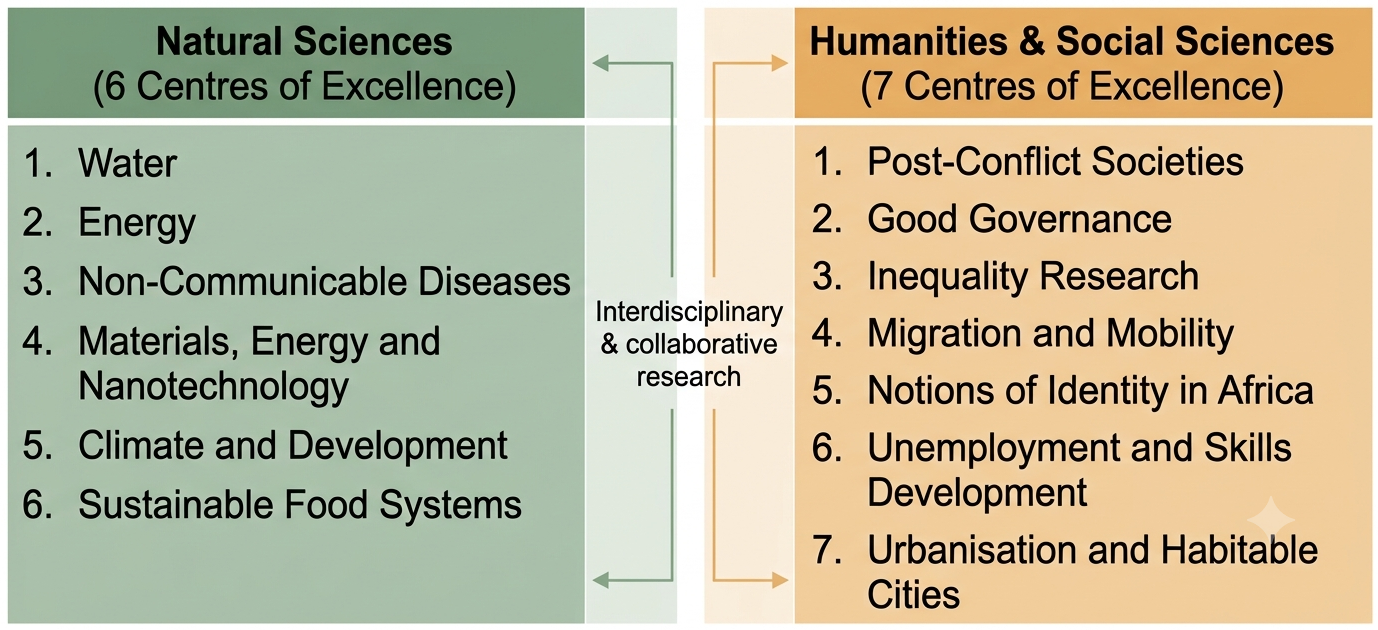
The 13 CoEs are organized into two broad but interconnected categories – natural sciences and humanities. The priority thematic research areas under the two categories are a shown below:
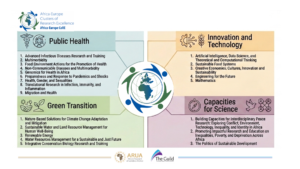
To compliment the CoEs, 22 Clusters of Research Excellence (CoREs) were established through a partnership between ARUA and the Guild of European Research Universities. The CoREs bring together more than 120 institutions across 44 countries in Europe, Africa and beyond aligned with the AU-EU Innovation Agenda’s four priority research areas. The four thematic priorities and the research focus areas for each of them are shown below.
2.3 Roles and Responsibilities of the Research Fellow
During the six‑month residency, fellows are expected to:
- Pursue a clearly defined research project aligned with the host institution’s or CoE/CoRE’s thematic priorities, which are achievable within the fellowship period.
- Contribute to interdisciplinary and cross‑institutional collaboration, including joint publications, proposal development and network‑building.
- Mentor early‑career scholars (e.g. PhD students, postdocs, early‑career fellows) through joint writing, project work, and skills‑building activities.
- Participate in retooling opportunities, training, and inter-institutional collaborations (including with Guild of European Research-Intensive Universities via CoREs) to enhance personal well-being, professional development, and research innovation.
- Implement a robust public engagement and knowledge‑translation strategy using seminars, workshops, policy dialogues, blogs, and ARUA Biennial Conference platforms.
- Contribute to ARUA’s strategic goals by producing high-impact outputs, exchanging knowledge across institutions, addressing continental challenges, and supporting the global competitiveness of African research
3.1. Eligibility Criteria
Applicants must:
- Demonstrate a strong track record of research and publication in an area aligned with the selected host institution/CoE/CORE research focus
- Show evidence of prior or ongoing collaborative research, preferably across institutions or countries, and clear potential to expand such collaborations through the fellowship.
- Present a feasible six‑month research plan with clearly defined outputs and a strategy for continuation beyond the fellowship, where applicable.
- Provide an institutional letter confirming support, leave or sabbatical arrangements, and return to their university at the end of the fellowship.
- Associate Professors who have just completed a tenure as Dean, Director or Head of Department/Centres are encouraged to apply.
- Women and applicants from historically under‑represented regions within the ARUA network are strongly encouraged to apply.
3.2. Selection Criteria and Process
Selection will be competitive and merit‑based, guided by:
- Academic excellence, research productivity and demonstrated leadership in the applicant’s field, relative to opportunity.
- Quality, feasibility and potential impact of the proposed research and engagement plan.
- Added value to ARUA’s broader research, training and advocacy agenda, including contributions to doctoral supervision, early‑career development and cross‑network initiatives.
- Candidates who can demonstrate that they already have ongoing work and will derive substantial benefit from the fellowship will be at a distinct advantage.
The fellowship provides the following:
- A six‑month research residency at the selected host institution.
- Return economy‑class airfare between the fellow’s home institution and the host institution or CoE/CORE.
- Monthly stipend of USD 2,500, intended to cover living expenses, local transport and health insurance.
- Monthly accommodation allowance of USD 750.
- One‑time research grant of USD 3,500 to support data collection, fieldwork, research assistance, software, or other justified research costs. This will be provided through the host institution or CoE/CoRE.
- Office space and access to institutional facilities, including libraries, laboratories (where relevant), and online resources, provided by the host.
- Relocation costs beyond the covered airfare are not included, and fellows are expected to make their own arrangements within the stipend and accommodation allowance.
Applicants must submit the following documents:
- Cover Letter (2 pages)
A cover letter outlining your motivation for applying for the fellowship and explaining how the award will support your ongoing research trajectory, professional development, and contribution to collaborative research within ARUA member universities. The letter should provide an overview of your experience in the relevant field, demonstrate how
you meet the eligibility criteria for mid-career researchers and indicate how the proposed fellowship will enable you to undertake substantial research outputs (e.g., a book project or a series of articles from unpublished data) within a six-month sabbatical-type placement. If you wish to be hosted at one of the ARUA CoE or Africa–Europe CoRE, you must specify your preferred host CoE/CORE. Applicants are encouraged to engage with their preferred host CoE/CORE in advance to align their proposed research focus with that of the host.
If you have previously spent time at or collaborated with the proposed host institution or CoE/CoRE, the cover letter should explain how this fellowship will deepen or extend that existing relationship. Applicants may also suggest potential collaborators. In addition, applicants should indicate whether they require a visa to visit the host or affiliated institutions and, if so, outline what is required and the estimated processing time.
- Curriculum Vitae (max. 10 pages)
A comprehensive CV including personal details, details of your doctoral degree (or equivalent) and subsequent academic appointments, research and teaching experience, record of research grants and funded projects, key research outputs, and a description of your contribution to jointly authored publications. The CV should also state your current institutional affiliation and position, confirming your mid-career status. Please provide the names and contact details of two referees. Shortlisted applicants will be required to request that their referees submit a brief report assessing their suitability for the fellowship. Referees should not be based at the proposed host Institution.
- Letter of Support from Home Institution
A formal letter from your home institution confirming institutional endorsement of your application (preferably from the Vice Chancellor or Deputy Vice-Chancellor), commenting on your suitability for the fellowship, and indicating that you will be granted leave and will return to your institution upon completion of the fellowship.
- Concept Note (max. 2,500 words)
The concept note should:
- Clearly state the research problem, objectives, and expected outputs (e.g., book manuscript, journal articles, policy briefs).
- Outline the conceptual and methodological approach
- Demonstrate alignment with the host institution’s or CoE/CoRE’s thematic focus and strategic objectives, including potential for collaborative and interdisciplinary work.
- Demonstrate that the proposed project is realistically implementable within the six‑month fellowship period or clearly outline concrete plans for its continuation beyond the fellowship, and indicate that you are already actively engaged in the relevant line of research.
- Show evidence of requisite collaborations, data, or other research materials necessary to undertake the proposed work will be an added advantage.
- Passport Biodata Page – A scanned copy of the biodata page of a valid passport.