Reimagining Breast Cancer In Africa: When Science Meets Reality

What if the biggest challenge in breast cancer care isn’t the lack of innovation… but the failure to deliver the innovation where it is needed most? Breast cancer today is no longer just a biological disease. In Africa, it is a health systems problem where scientific progress often fails to meet real-world limitations. And in that gap, sadly, patients are lost.
The Illusion of Progress
Globally, breast cancer research is advancing at an extraordinary pace.
Newer technologies like high-resolution imaging, molecular subtyping, liquid biopsies for real-time tumour tracking and AI-supported diagnostics are transforming how diseases are detected and treated.
In other words, from a scientific standpoint, medicine is better equipped than ever before.
HOWEVER, in many African healthcare settings, the emerging technologies and diagnostic tools remain out of reach; often unavailable, unaffordable, or impractical for routine clinical care.
As a result, as science moves forward, access remains at a standstill.
Where Care Really Begins
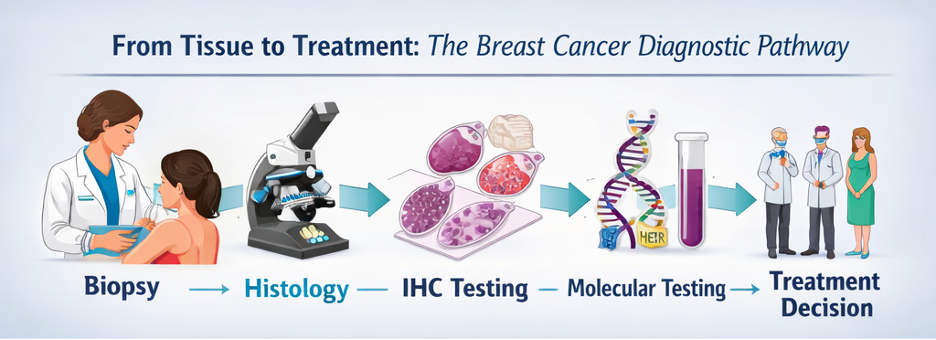
Every breast cancer care diagnosis begins in the laboratory.
From tissue analysis to hormone receptor testing and molecular testing, these laboratory results determine how patients are treated. This is the foundation of precision medicine.
Yet across many low-resource settings, the laboratories face major challenges, including:
- Limited infrastructure and diagnostic equipment
- Costly laboratory reagents and consumables
- Shortage of trained workforce
- Delayed turnaround times.
When diagnosis is delayed or incomplete, everything that follows is affected, simply put, treatment is only as good as the diagnosis behind it.
Understanding the real Gap
We understand the biology of breast cancer. We have the diagnostic tools and emerging therapeutic strategies. The challenge is translating these advances into consistent and accessible care for patients who need them most.
This is not just a resource problem. It is a translation problem, the gap between scientific discovery and real-world impact.
A Practical Opportunity to close the gap: Smarter Biomarkers
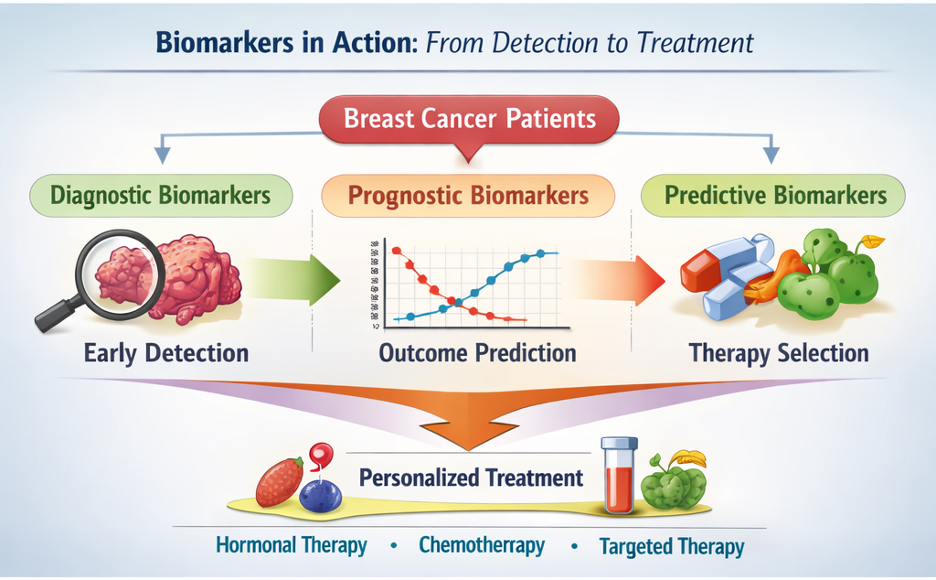
One of the most realistic ways to close this gap is through biomarker development, not high-cost innovation, but context-appropriate solutions.
Affordable, scalable, clinically useful biomarkers can transform care by supporting early detection, improving patient classification, guiding therapy selection and reducing unnecessary costs.
The goal is not to imitate high-income healthcare systems, but to design adaptable solutions that work within existing realities.
When Science Meets the System
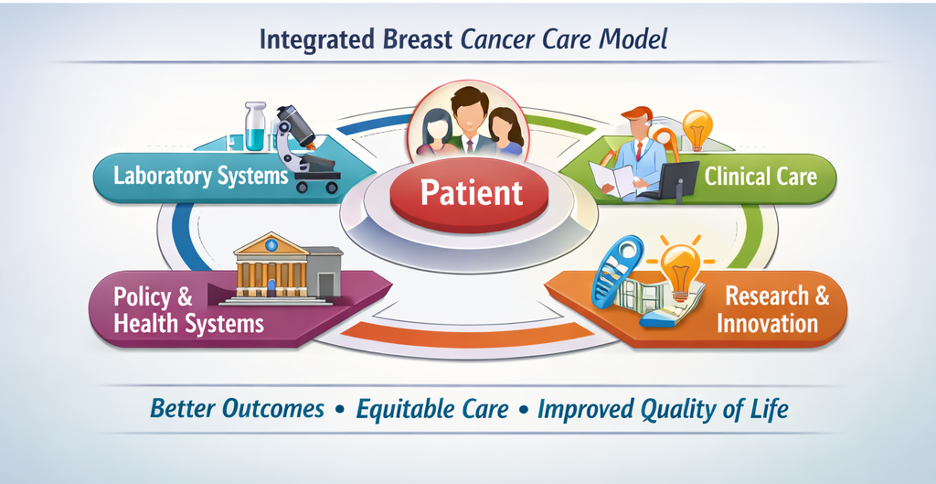
Even when these gaps are eventually closed, the health system challenges remain. Many patients are faced with other intertwined constraints as depicted below:

In such scenarios, even the best diagnostics may not improve outcomes if they are not well integrated into patient care.
Without integration, data does not become action.
From Discovery to Delivery
To truly improve breast cancer outcomes in Africa, innovation must move beyond the research laboratory.
It must be embedded into:
- Clinical workflows
- Policy frameworks
- Health financing systems
- Local research ecosystems
Key to this paradigm shift is recognition of the central role of medical laboratory scientists beyond just service providers. They are key contributors to the diagnosis, innovation, translation and precision care.
Beyond the Disease
Breast cancer care does not end with diagnosis or treatment.
In many African contexts, patients also face emotional distress, financial burden and limited support systems, all of which affect treatment adherence and in turn outcomes.
Our research in Nigeria highlights how these non-medical factors directly shape patient survival. Therefore, care must go beyond biology to include the human experience of disease.
Rethinking the Future
The question is not simply how Africa can adopt global innovations.
But perhaps the better question is:
How can innovation be redesigned for African realities?
Because progress is not just about advancement. It is about relevance, accessibility and impact.
Final Thought
Breast cancer care is evolving, but not evenly.
Closing this gap will require more than new technologies, it will require stronger laboratory systems, investment in research, affordable diagnostics and policies that prioritise access.
Beyond action, the conversation must continue; bringing together researchers, clinicians, policy makers and communities to generate practical context-driven solutions.
Because the true power of science lies not only in discovery…. but in its ability to reach the people who need it most.
Biography
Dr Onyekachi Ewa Ibe is a Lecturer and Medical Laboratory Scientist at Ebonyi State University, Abakaliki, Nigeria, ARUA/Mastercard Foundation Post-Doctoral fellow, hosted by the ARUA Centre of Excellence for Non-Communicable Diseases, University of Nairobi. She is a beneficiary of the ARUA Early Career Researchers Fellowship sponsored by the Mastercard Foundation and Carnegie Corporation. More…


