Is Technology a Job Thief or a Job Creator?

A fear as old as innovation
From the advent of mechanisation in the 19th century to today’s fast-paced advances in technology and innovation, there has always been one persistent fear ~ will machines take our jobs? This question, which was previously a quiet concern, is now the talk of the town across all borders, income groups, professions and cultures. Digitisation and automation hit differently across different scenarios.
- A factory worker in Southeast Asia fears automation.
- A call-centre employee in Africa worries about redundancy
- A graphic designer in Europe questions the future of his creative work.
The truth, however, is more complex than the popular narrative that “technology is a ruthless job thief”.
The historical paradox of progress: why technology has not killed jobs
If indeed technology were a job destroyer, then modern economies that have truly embraced technology would be facing widespread and permanent unemployment. However, ILO data tells a different story
- Global employment has continued to grow over time, with the global employment-to-population ratio remaining above 57%
- Global unemployment averaged 5-6% globally (ILO)
This data points to an intersection of technology and job creation.
- About 14% of jobs face the risk of automation
- At the same time 27% new roles are emerging in digital sectors (OECD).
This reveals a critical insight: technology simultaneously destroys and creates jobs. In this age of digitisation, while clerical and other routine roles are on the decline, there are new jobs and careers emerging in software development, cybersecurity, data analysis, and online entrepreneurship, among others.
Artificial intelligence, which is often seen as independent tech, largely depends on human input from design, training to oversight and ethics. Over 60% of AI tasks require human involvement (World Economic Forum).
The winner-loser game with education as the great divider
Technology is not a neutral force after all – there are winners and losers!
Therefore, the pertinent question is; who is the ultimate beneficiary of tech…who gets to take the bag home? Ultimately, “He who pays the piper dictates the tune”. It is no surprise that the high-income or developed countries that finance and develop innovations are better positioned to tap the benefits and new opportunities. On the other hand, the lower-income countries face:
- Job losses/displacement without matching job creation
- Limited access to the digital infrastructure
- Glaring skills gap to exploit and benefit from the opportunities of digitisation and automation
This imbalance points to a critical truth that unemployment in the era of technological advancement is not a failure of innovation – it is a failure of policy. Policy alignment is key in keeping up with evolving technological advancements. Central to this shift is education – continued learning and retooling/reskilling are key to adapting and thriving in the fast-paced technology-driven job market. Those who adapt and keep up with technological advancements will thrive, while those who do not will certainly be left behind. Therefore, there is a need for a paradigm shift in education – from a one-time phase of life to a lifelong, adaptive system aligned with technological change.
Work is more than a paycheck…
Job opportunities are more than a source of income. With a job, there is dignity, identity and a sense of purpose. Therefore, when technology disrupts employment is not just an economic loss but a deeply personal loss. Job losses are immediate, visible and emotionally disruptive. However, tech plus human is a super combo that is evident in how tech has positively transformed the medical sector, agricultural sector and the creative economy. Artists now reach global audiences. Farmers access smarter tools. Healthcare systems improve efficiency and outcomes
Despite the positive impact on these sectors, the “Job thief” narrative lingers on – but why? It is because job creation is gradual, less visible and often skewed in favour of those who are better equipped to benefit from emerging opportunities.
The debate should move from “Are jobs being lost?” to:
- What quality of jobs are being created?
- Who has access to them?
- How can human–technology collaboration be optimized?
Turning the technology-driven job disruption into opportunity
The pertinent issue of whether technology is a job thief or a job creator will be determined by the choices we make. Positive outcomes will require policy alignments towards:
- Education and continuous reskilling
- Digital entrepreneurship ecosystems
- Inclusive growth
- Global and regional collaboration frameworks
The change will be realized if we turn disruption into opportunity – not resisting the inevitable disruption but governing it effectively to our benefit.
Africa’s opportunity: Innovation as Job Engine
For Africa, the ‘young continent’ with a high youth unemployment crisis, the stakes are high. With a rapidly growing youth population, the continent faces a pressing unemployment challenge.
The desired tech-led transformation will be realized not by chance, but through intentional, innovation-led policy. If well-harnessed, technology offers a pathway to transformation through:
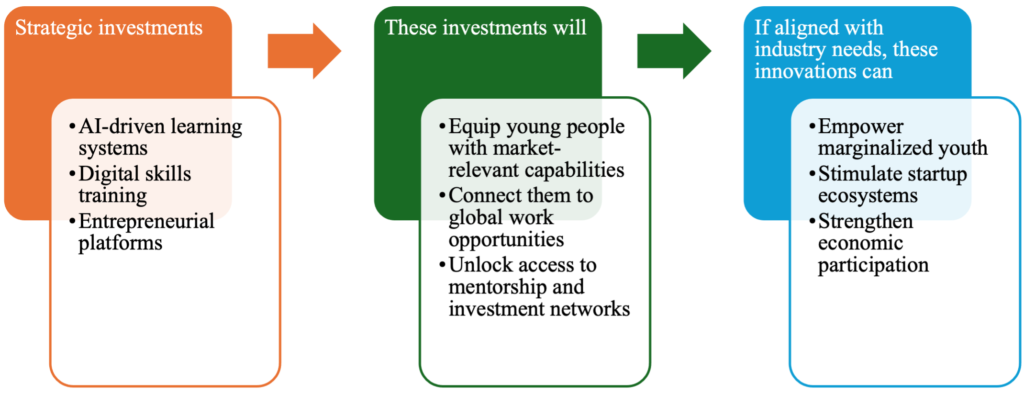
Turning fear into strategy: the role of research
When creativity and technology converge, disruption becomes an opportunity to be harnessed. At the ARUA Centre of Excellence for Unemployment and Skills Development (ARUA,CoE-USD), we are on a mission to empower African youth with digital and entrepreneurial skills that promote self-reliance and tackle unemployment and poverty across the continent. From fear-based narratives to generating research evidence to guide
- Understanding the psychological roots of anxiety around technology
- Designing innovative, actionable digital interventions
- Expanding access to digital capacity-building tools without barriers
Ultimately, technology is neither inherently a job thief nor a guaranteed job creator but a tool whose impact will be shaped by policy decisions, education shifts and targeted investments. This will transform disruption into opportunity by turning technology into a powerful engine for job creation, dignity and shared prosperity as envisioned by the Africa Union’s Agenda 2063 | African Union and mirrored in the Mastercard Foundation’s The Young Africa Works strategy
The pertinent question is… will we shape the transformation or be shaped by it?
Biography
Dr Cynthia Mwau is a Lecturer in the Department of Mathematics and Actuarial Science, Kisii, Kenya. She is a recipient of the ARUA-Mastercard Foundation Fellowship and a postdoctoral researcher at ARUA-CoE Unemployment and Skills Development, University of Lagos, Nigeria. More…
Mentor: Prof. Sunday Adebisi, the Centre Director (sadebisi@unilag.edu.ng)


