ARUA Champions Africa-Led Research and Graduate Training at EAIE 2026 in Glasgow

The African Research Universities Alliance (ARUA) strengthened its international engagement at the 2026 European Association for International Education (EAIE) Conference and Exhibition, held in Glasgow from 8th to 11th September.
Participating under the auspices of the ‘Study and Research in Africa (SRiA)’ initiative that is funded by European Commission, ARUA joined other regional higher education bodies, including the Association of African Universities (AAU), Inter-University Council for East Africa (IUCEA), the Southern African Regional Universities Association (SARUA) and African Network for Internationalization of Education (ANIE), in presenting African priorities to a global audience. ARUA was represented by Prof. Jane Ambuko (Director of Training and Research), and Prof. Nelson Boniface (Deputy Vice Chancellor of Research at the University of Dar es Salaam, UDS), one of ARUA’s 23 member universities.
The conference was a great opportunity for ARUA and UDS to engage universities, consortia, development partners and organisations seeking stronger links with African research institutions. At the SRiA booth, Prof. Ambuko who was flagged by Prof. Boniface delivered a presentation titled ‘Enhancing Research and Graduate Training in African Universities.’ The presentation highlighted some of the key challenges affecting graduate training in Africa – from low completion rate (due to lack of supervision capacity and funding) to the disconnect between the graduate/PhD research and real world/societal challenges that research should address. She then presented ARUA’s central proposition that no single university has all the capacity (human and infrastructural) required to address Africa’s complex challenges.
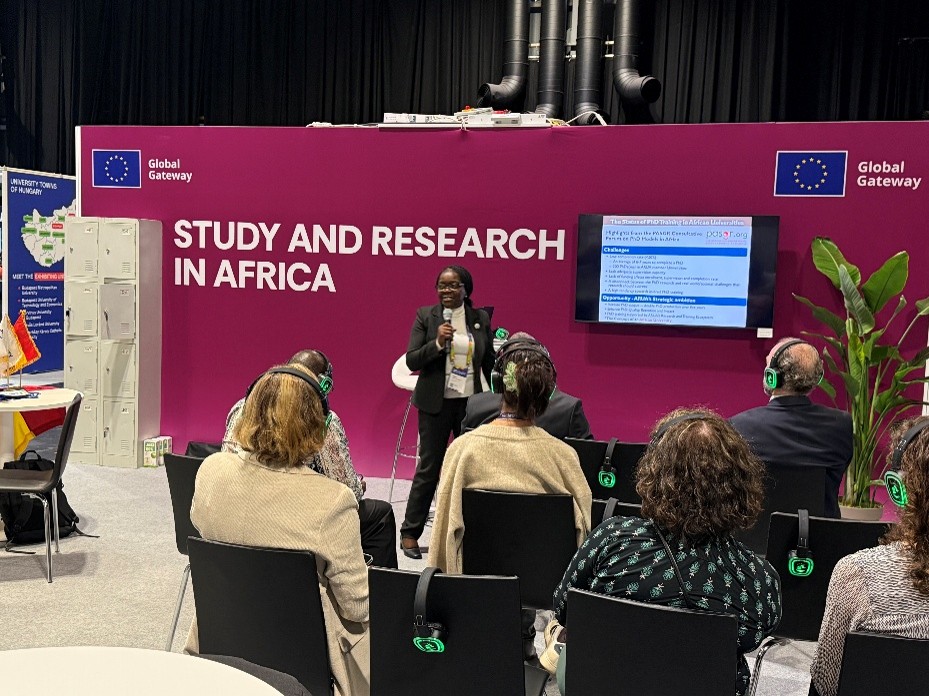
However, universities working together can create the scale, expertise and supportive environments needed for excellent research and graduate training. She highlighted ARUA’s Concept of an African University where PhD training is supported by a rich research and training ecosystem. This collaborative approach is already taking shape through ARUA’s 23 research-intensive universities, 13 Centres of Excellence and 22 Africa-Europe Clusters of Research Excellence established with The Guild of European Research-Intensive Universities. The Clusters alone connect more than 400 researchers and over 120 institutions across 44 countries, illustrating the reach that becomes possible when institutional strengths are brought together around shared research challenges.
A key message from the presentation was that while ARUA is keen to increase the number of PhD holders graduating from its member Universities, Africa needs more than increased PhD numbers. Doctoral education must prepare researchers who can generate knowledge and innovation that respond to continental and global priorities, including Agenda 2063, the Sustainable Development Goals and the AU-EU Innovation Agenda. This requires a shift from isolated doctoral programmes to collaborative training, from single supervision to co-supervision and mentorship, and from limited mobility to networked and split-site research experiences.
The presentation also situated the PhD within a longer researcher-development journey. Producing a doctoral graduate is only the beginning; African universities must also retain and support postdoctoral researchers, early-career researchers and future research leaders. As Prof. Ambuko emphasized, ‘The PhD degree is not the destination.’ The desired outcome is a confident, connected and well-rounded researcher with interdisciplinary, digital, innovation, policy-engagement and leadership capabilities.
The EAIE Conference brought together more than 7,000 international education professionals, offering an important platform for ARUA to communicate this vision and identify partners ready to help translate it into action. Following the presentation, several organizations and consortia expressed interest in engaging ARUA on research and training initiatives.
The PhD degree is not the destination. The goal is a confident, connected and well-rounded researcher equipped to generate knowledge and innovation that will lead to impact on society
These conversations point to opportunities for collaborative PhD programmes, co-supervision, researcher mobility, postdoctoral development, joint research and innovation, and stronger institutional research capacity. They also reinforce a principle at the heart of ARUA’s engagement: international partnerships should expand what African graduate researchers can access, learn, contribute and become, while strengthening the institutions and research ecosystems in which they work.
ARUA’s participation at the EAIE therefore marked a successful conference appearance, advancing the network’s role as a connector of African research and training capacity. It opened new pathways for equitable partnerships capable of strengthening graduate training and producing knowledge with impact in Africa and beyond.


