ARUA Showcases Transformative Research Tracking Platform at CB-SITS Africa Webinar

The Africa Research Universities Alliance (ARUA) has highlighted the transformative potential of the Capacity Building and Scientific Impact Tracking System (CB-SITS Africa), a new platform designed to strengthen how research impact is measured and communicated across Africa.
Launched during a well-attended webinar with over 130 participants, the session brought together key partners to demonstrate how the platform is reshaping the monitoring of research capacity-building initiatives.
Representing ARUA, Dr Emmanuel Abbey outlined how the Alliance—comprising 23 member universities—is leveraging the platform to transform the management of its early career researcher programmes. He noted that CB-SITS Africa now serves as an integrated dashboard linking narrative reporting with AI-processed bibliometric data. This allows ARUA to track fellows’ contributions to the Sustainable Development Goals (SDGs) on its Partner Page.
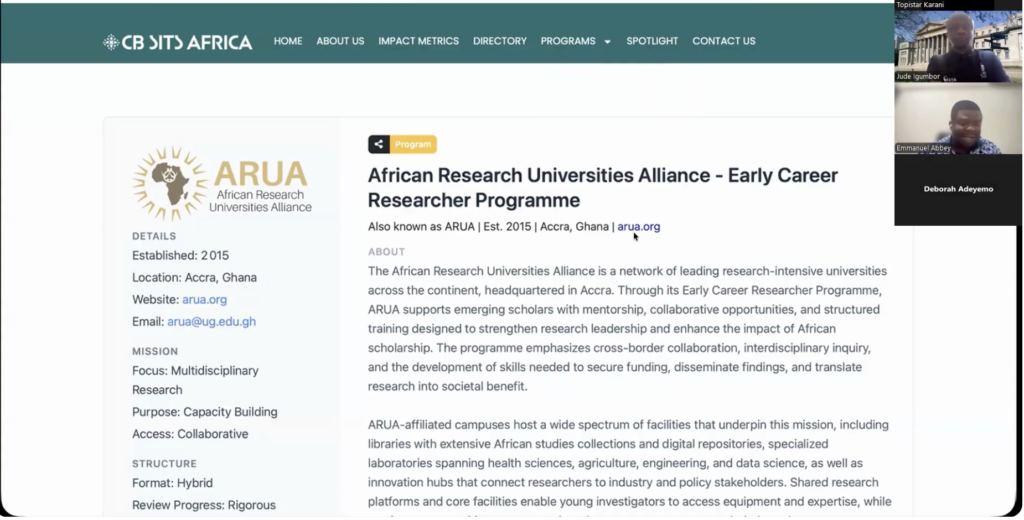
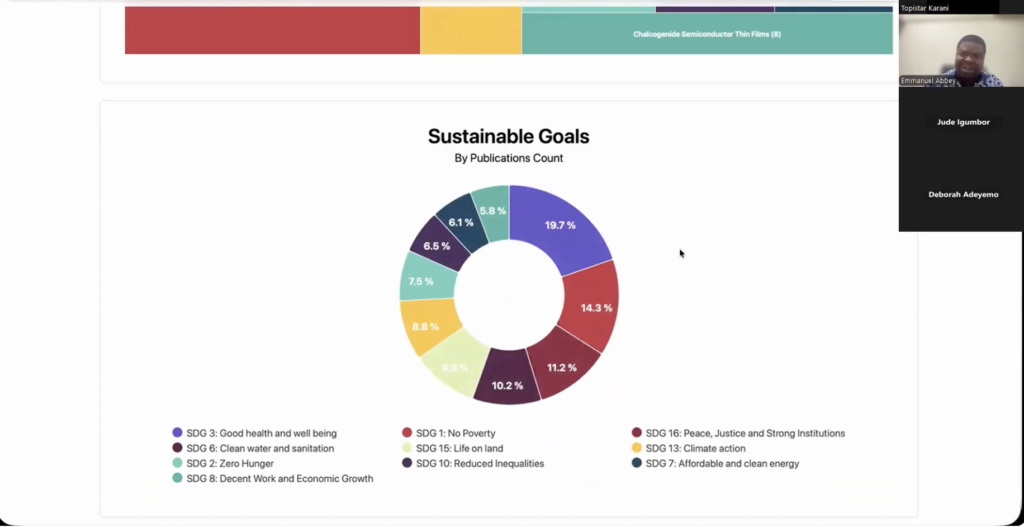
Dr Abbey contrasted this with previous approaches, which relied heavily on fragmented Excel-based tracking and incomplete self-reported CVs. “It was impossible to access real-time bibliometric data or understand fellows’ research trajectories before joining the programme,” he explained. “Now, we can engage more effectively with stakeholders, identify strengths and gaps, and strategically target future recruitment.”
Some ARUA fellows testified to the platform’s role in increasing both visibility and accountability. One fellow noted that the system “gives visibility to your work… you can see at a glance what each researcher is doing,” while another highlighted how publicly accessible profiles “speak for me” and encourage greater research productivity.
Beyond ARUA, partner institutions also reported significant gains. The African Institute for Mathematical Sciences (AIMS) noted that it can demonstrate real-time scientific output, including hundreds of publications and thousands of citations, alongside strong evidence of grant leverage among its fellows. Similarly, the Consortium for Advanced Research Training in Africa (CARTA) reported reducing reporting timelines from several months to a largely automated process, while other partners reported using the platform to track policy and societal impact.
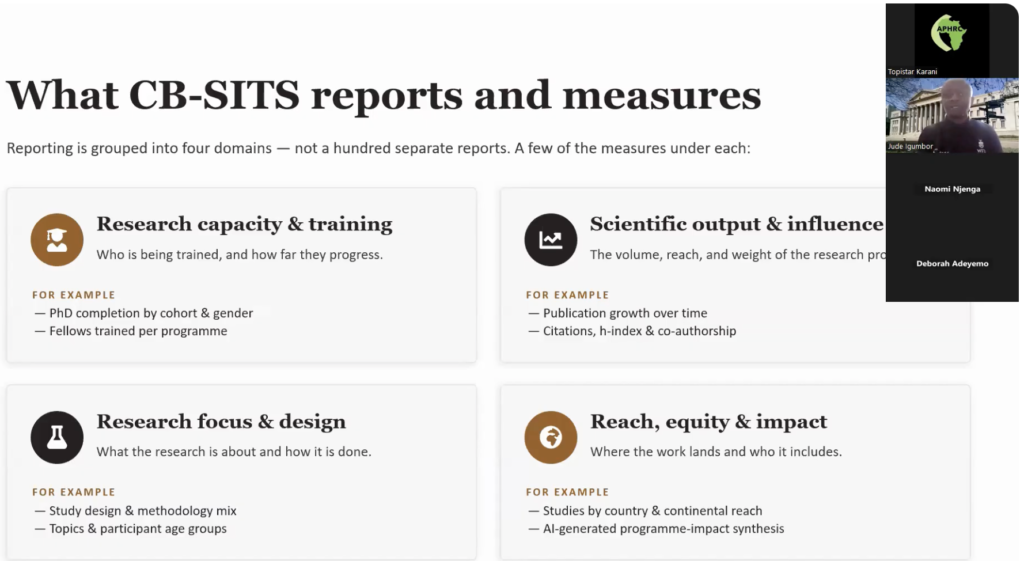
| About CB-SITS Africa Supported by the Andrew Carnegie Foundation (formerly the Carnegie Corporation of New York), CB-SITS Africa consolidates fragmented data into a unified system that tracks the long-term trajectories and impact of African researchers. At its core, the platform introduces a standardised framework that goes beyond traditional metrics such as publication counts. It captures a more holistic picture of research capacity development, including career progression, leadership roles, and contributions to societal outcomes. By creating dynamic public profiles for programme beneficiaries, it enhances visibility while providing credible, data-driven insights for stakeholders. For funders, the system offers a powerful tool to demonstrate the value of their investments. It enables real-time tracking of outcomes, supports evidence-based proposal development, and improves accountability by illustrating how initial grants catalyse further funding and impact. A key feature of CB-SITS Africa is its co-creation process. Participating organisations worked collaboratively to define standardised indicators suitable for diverse programmes, while ensuring high data quality through continuous validation. The platform’s human-centred design has been critical in supporting adoption, with an evolving “plug-and-play” model that allows institutions to independently manage their data and profiles. As ARUA and its partners continue to scale the platform, CB-SITS Africa is emerging as a critical tool for advancing transparency, collaboration, and evidence-based decision-making in African research ecosystems. |


