Can Agricultural Waste Save Our Soils? How Biochar can Help Farmers Fight Soil Erosion

By Dr. Ravaka Andriatsitohaina
After heavy tropical rain, when the soil is washed away, many farmers witness the same alarming scene: water rushing across their fields, carrying away the thin layer of soil their crops depend on. What disappears in minutes may have taken decades to form.

“Sometimes after a heavy rain, you can actually see the soil leaving the field”
explains Solo, a farmer from Mahitsy, Madagascar.
This is not an isolated observation; it reflects a growing challenge in the tropics. As rainfall becomes more intense and unpredictable, soil erosion is accelerating, threatening both food production and livelihoods.
Why tropical soils are vulnerable
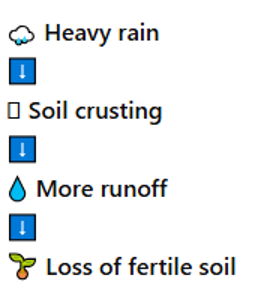
Most tropical soils contain low levels of organic matter. This makes them extremely fragile and prone to erosion, especially under heavy rain. High intensity rainfall on such bare soils leads to compaction and formation of surface crusts, which in turn prevent water from soaking into the ground, leading to increased runoff and erosion.
At the same time, limited soil cover and insufficient soil management practices increase the negative impact of intense rains. This scenario is further aggravated by high rainfall intensity due to climate change.
Without any action, we will continue to lose fertile soil year after year.
Why soil erosion affects us all
The negative impact of soil erosion does not just affect the farmer. When soils lose nutrients, crop yields decline, thereby threatening food security and livelihoods. Farmers are forced to contend with low yields or incur extra costs of production on fertilisers. From an environmental perspective, the eroded soil ends up in rivers, creating a secondary problem of river sedimentation.
THEREFORE, there is a call to action to protect the soils as an intervention towards food security, sustainable agriculture and climate adaptation.
Building soils that can withstand intense rain
Could everyday agricultural waste like coconut shells and rice husks help farmers protect their soils from being washed away by heavy tropical rains?
Turning farm waste into a soil solution
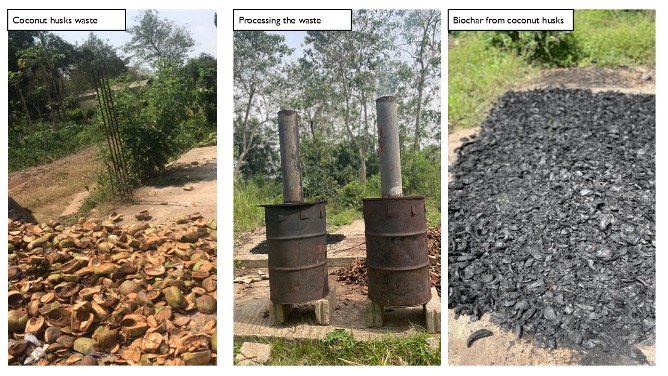
We investigated a material called biochar — made by turning farm waste into a charcoal-like material that helps the soil stay healthy and keep more water for crops.
We wanted to find out whether this material could help the soil absorb and keep more rainwater instead of letting it quickly run across the surface during heavy storms.
To test this, we recreated a scenario of strong tropical rains’ effect on normal soil compared to soil that was mixed with biochar made from coconut shells or rice husks.
Our research findings: Biochar can reduce surface runoff
- Soil that was treated with biochar easily absorbed water, leading to less runoff – the soil held water for longer and the runoff was delayed. In normal (untreated) soil, water flowed quickly across the surface after the rain began.
The runoff from soils treated with biochar was reduced by 20 – 40%
- Biochar helped to hold the soil together and resist the force of erosion. Normally, the force of strong raindrops breaks the soil apart and carries the sediments away in the runoff. Biochar helped the soil to aggregate better, more stable and more resistant to erosion.
- Biochar made from coconut shells performed better than that made from rice husks. When applied at moderate levels of 10 tons per hectare, coconut shells biochar consistently improved water absorption and reduced the runoff, ultimately reducing soil erosion.
From research to real-world application
- Produce biochar from locally available residues such as coconut shells or rice husks
- Apply moderate amounts of biochar – about 10 tons per hectare (mix with the topsoil)
- Combine biochar with organic amendments to enhance overall soil fertility
These are simple, affordable and locally feasible solutions which are backed by evidence from research. If adopted, they will not only help farmers to protect their soil from erosion but also put agricultural waste to good use instead of discarding to landfills or burning.
These practices can be integrated into climate-smart agriculture programs, soil restoration strategies, and circular economy approaches that valorise agricultural waste.
The evidence is clear:
Biochar improves infiltration, reduces runoff, and strengthens soil structure under intense rainfall conditions.
It is time to act
If we want to build resilient agricultural systems in tropical regions, protecting soil must become a priority—not an afterthought.
Soil loss is not inevitable—but preventing it requires decisive action now.
Biography
Dr. Ravaka ANDRIATSITOHAINA is a Lecturer at the University of Toamasina, Madagascar and an ARUA-CD Fellow 2026, hosted by the Institute of Applied Science and Technology, University of Ghana. She is a beneficiary of the ARUA Early Career Researchers Fellowship sponsored by the Mastercard Foundation. More…


