Dr. Mirriam Ethel Nyenje

“I think the most important thing what I’ve learned is that coordination and collaboration is important [..] it has really opened up our mind to say, okay, so this is what translational science is all about.”
Dr. Mirriam Ethel Nyenje, Senior Public Health Microbiologist and Head of the National Genomics Reference Laboratory at the Public Health Institute of Malawi, reflects on the power of collaboration during the closing week of the AU-EU Health Partnership – a programme designed to strengthen research on mpox and Lassa fever.
During her stay at Makerere University, Mirriam was really encouraged to see the research being conducted by her peers in the Translational Lab. What really caught her eye was the development of the gene extraction kit, which can be used to break down and reduce the genetic makeup of bacteria. “If other institutions are doing the same in Africa, why not us?” she said. Looking back on the Covid-19 pandemic where a lack of supplies and chemicals was a huge issue in Africa, Mirriam hopes that when these gene kits are produced locally, they would not have to rely on Europe or other parts of the world to manufacture reagents to support testing and diagnosis of diseases like mpox.
Mirriam reflects on how the fellowship has really opened her eyes to the importance of good collaboration and coordination in translational research. Within the African context, however, there are still some barriers that hinder researchers in countries like Malawi to exchange samples and work with colleagues in other African countries. She argues that Africa CDC can be a good platform for strengthening collaboration between member states and to bypass some of the trust issues that are hindering collaboration today.
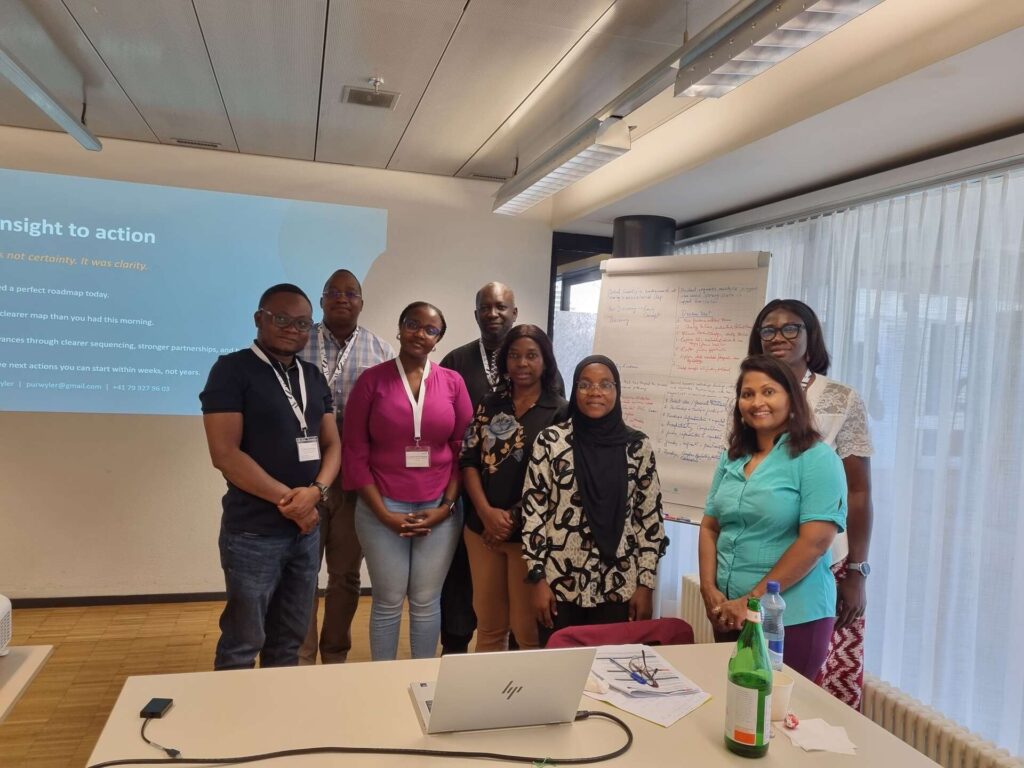
One of the issues when it comes to outbreak response, Mirriam says, is that researchers are being left out of the rapid response teams. She argues that if researchers are included from the beginning, they would be able to help by deploying diagnostic kits and point-of-care (POCT) platforms to test facilities in rural areas and detect the outbreak at a much earlier stage. They would be able to isolate infected people and break the transmission cycle, reducing both the mortality and the cost.
When talking about vaccines, she notes that although a vaccine is deemed safe in Europe, the vaccine might not work as well in Africa because of the different genetic makeup. “I’ve learned that indeed, if we have those locally produced vaccines tested on our own people, the efficacy and even how that vaccine works will have a greater impact than the ones that are procured outside”. She argues that if African countries had better capacity to produce more vaccines themselves, they would not have to wait for and rely on partners to provide vaccines when there is an outbreak. “We know in Malawi when it’s cholera season and where the hotspots are in different districts. Why can’t we give our people these vaccines before the rainy season comes?” Instead, she would like African countries to be able to decide when to administer vaccines and focus more on prevention rather than reaction, which again would lessen the burden on the health sector.
| Meet Mirriam Dr. Mirriam Ethel Nyenje is a senior public health microbiologist and health security systems expert who currently serves as Head of the National Genomics Reference Laboratory at the Public Health Institute of Malawi. Her expertise spans global health security, One Health collaboration, emergency preparedness, and translating scientific data into policy and action. She holds a PhD and MSc in Medical Microbiology from the University of Fort Hare and a BSc in Biomedical Sciences from the University of Zambia. Research focus: Developing new public health surveillance tools that can triage infections outside of Malawi’s centralised labs Host institutions – Makerere University – Supervisor: Prof. Damalie Nakanjako – University of Glasgow – Supervisor: Prof. Lilach Sheiner – University of Bern – Supervisor: Dr. Phaedra Simitsek |
“I think the most important thing what I’ve learned is that coordination and collaboration is important [..] it has really opened up our mind to say, okay, so this is what translational science is all about.”
Dr. Mirriam Ethel Nyenje, Senior Public Health Microbiologist and Head of the National Genomics Reference Laboratory at the Public Health Institute of Malawi, reflects on the power of collaboration during the closing week of the AU-EU Health Partnership – a programme designed to strengthen research on mpox and Lassa fever.
During her stay at Makerere University, Mirriam was really encouraged to see the research being conducted by her peers in the Translational Lab. What really caught her eye was the development of the gene extraction kit, which can be used to break down and reduce the genetic makeup of bacteria. “If other institutions are doing the same in Africa, why not us?” she said. Looking back on the Covid-19 pandemic where a lack of supplies and chemicals was a huge issue in Africa, Mirriam hopes that when these gene kits are produced locally, they would not have to rely on Europe or other parts of the world to manufacture reagents to support testing and diagnosis of diseases like mpox.
Mirriam reflects on how the fellowship has really opened her eyes to the importance of good collaboration and coordination in translational research. Within the African context, however, there are still some barriers that hinder researchers in countries like Malawi to exchange samples and work with colleagues in other African countries. She argues that Africa CDC can be a good platform for strengthening collaboration between member states and to bypass some of the trust issues that are hindering collaboration today.
One of the issues when it comes to outbreak response, Mirriam says, is that researchers are being left out of the rapid response teams. She argues that if researchers are included from the beginning, they would be able to help by deploying diagnostic kits and point-of-care (POCT) platforms to test facilities in rural areas and detect the outbreak at a much earlier stage. They would be able to isolate infected people and break the transmission cycle, reducing both the mortality and the cost.
When talking about vaccines, she notes that although a vaccine is deemed safe in Europe, the vaccine might not work as well in Africa because of the different genetic makeup. “I’ve learned that indeed, if we have those locally produced vaccines tested on our own people, the efficacy and even how that vaccine works will have a greater impact than the ones that are procured outside”. She argues that if African countries had better capacity to produce more vaccines themselves, they would not have to wait for and rely on partners to provide vaccines when there is an outbreak. “We know in Malawi when it’s cholera season and where the hotspots are in different districts. Why can’t we give our people these vaccines before the rainy season comes?” Instead, she would like African countries to be able to decide when to administer vaccines and focus more on prevention rather than reaction, which again would lessen the burden on the health sector.
| Meet Mirriam Dr. Mirriam Ethel Nyenje is a senior public health microbiologist and health security systems expert who currently serves as Head of the National Genomics Reference Laboratory at the Public Health Institute of Malawi. Her expertise spans global health security, One Health collaboration, emergency preparedness, and translating scientific data into policy and action. She holds a PhD and MSc in Medical Microbiology from the University of Fort Hare and a BSc in Biomedical Sciences from the University of Zambia. Research focus: Developing new public health surveillance tools that can triage infections outside of Malawi’s centralised labs Host institutions – Makerere University – Supervisor: Prof. Damalie Nakanjako – University of Glasgow – Supervisor: Prof. Lilach Sheiner – University of Bern – Supervisor: Dr. Phaedra Simitsek |


