Dr. Mariam Kehinde Sulaiman

“What I’ve realised from this fellowship is that there’s no strong collaboration between African researchers and universities for Lassa fever and mpox“
Dr. Mariam Kehinde Sulaiman, Medical microbiologist and virologist at the University of Ilorin, Nigeria, reflected on the realities of intra-Africa research collaboration during the closing week of the AU-EU Health Partnership – a programme designed to strengthen research on mpox and Lassa fever.
During the European leg of the fellowship, Mariam spent time reviewing existing literature and noticed a pattern: West-African countries such as Sierra Leone have long collaborated with European partners such as Germany on Lassa fever, a disease predominantly found in West-Africa. East African fellows are studying mpox and collaborating with their own European partners. Even though they are working on different pathogens African researchers would benefit greatly from collaborating with each other and sharing research findings. “Everybody is doing different things in their own little corners”, she said.
A vivid contrast emerged when she witnessed how colleagues from Radboud University responded to the recent Hantavirus outbreak. They immediately mobilised their international network, reaching out to experts from Brazil and Italy to exchange knowledge and experience. “That is not very common in this part of the world [Africa],” she noted.
When asked how the fellowship has changed her views on translational research in health sciences in Africa, Mariam was candid: her institution simply does not have the infrastructure needed to support the full pathway from discovery to application. “People do science, but they don’t think outside of the box in terms of translational research because we don’t have the infrastructure.” Changing this, she stressed, requires intentional dialogue with university leaders and policymakers. Researchers must be equipped and encouraged to collaborate with partners from outside of Nigeria if they are to develop innovations such as diagnostic kits. “I thought it was just getting to the lab, putting it together, and then it’s just out there. But I realised that I need so much more. If I don’t collaborate with people outside of Nigeria, it’s not going to be possible.”
Beyond practical skills, building a research network became one of the most valuable aspects of her fellowship. She has already begun discussions with colleagues at the University of Ibadan to establish a collaboration. Fellows were also encouraged by the supervisors at Radboud University (Prof. Benjamin Mordmüller, Prof. Marien De Jonge & Prof. Quirijn de Mast) to start drafting new proposals that could spark future joint projects. “It’s not just talk, it is action, encouragement and the willingness to work together” she noted.
Mariam also highlighted the financial constraints that shape research training in Nigeria. Without grant funding, both students and supervisors must pay for research expenses themselves. As a result, she must design student projects carefully, ensuring they remain “meaningful but inexpensive.”
Her visit to the University of Ibadan offered a glimpse of what is possible. There, she learned about innovative, low-cost in-house Polymerase Chain Reaction (PCR) kits used to diagnose mpox, a practical alternative to expensive commercial kits imported from abroad. But cost is only part of the challenge. Procurement delays for reagents can stretch for weeks or months, jeopardising project timelines. “The procurement process is long and cumbersome,” she said. “But with these simple reagents, we can get them locally in Ghana and the work can be done without any delays.”
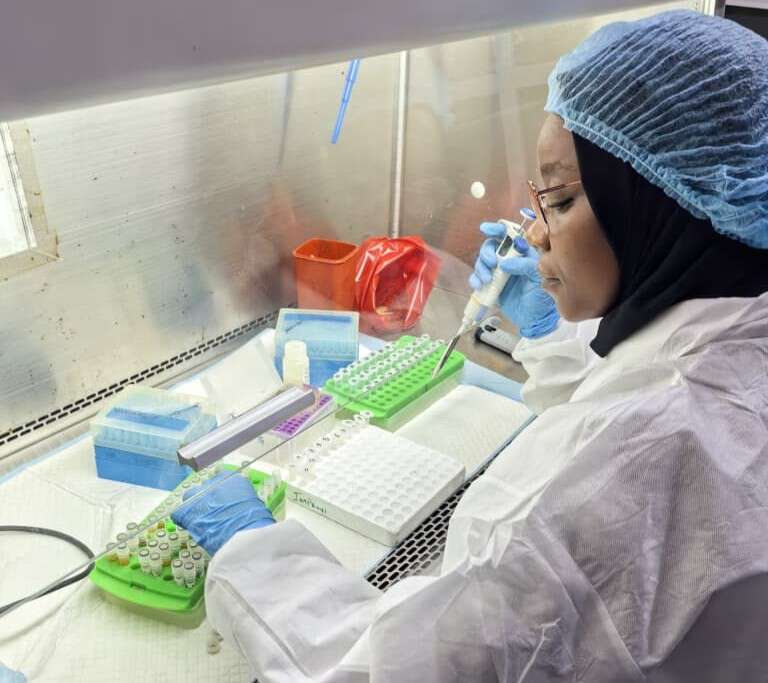
| Meet Mariam Dr. Sulaiman coordinates the Molecular Diagnostic and Research Laboratory and is involved in viral diagnostics, molecular epidemiology, and infectious disease surveillance. She completed her PhD at the University of Surrey and has since been actively involved in research and postgraduate supervision focused on improving diagnostic capacity and outbreak preparedness in resource-limited settings. Research focus: Developing a locally producible diagnostic kit for Lassa fever Host institutions – University of Ibadan – Supervisor: Dr. Adeola Fowotade – Radboud University – Supervisors: Prof. Benjamin Mordmüller, Prof. Marien De Jonge & Prof. Quirijn de Mast – Pompeu Fabra University – Supervisor: Prof. Andreas Meyerhans – University of Bern – Supervisor: Prof. Carmen Faso |
“What I’ve realised from this fellowship is that there’s no strong collaboration between African researchers and universities for Lassa fever and mpox“
Dr. Mariam Kehinde Sulaiman, Medical microbiologist and virologist at the University of Ilorin, Nigeria, reflected on the realities of intra-Africa research collaboration during the closing week of the AU-EU Health Partnership – a programme designed to strengthen research on mpox and Lassa fever.
During the European leg of the fellowship, Mariam spent time reviewing existing literature and noticed a pattern: West-African countries such as Sierra Leone have long collaborated with European partners such as Germany on Lassa fever, a disease predominantly found in West-Africa. East African fellows are studying mpox and collaborating with their own European partners. Even though they are working on different pathogens African researchers would benefit greatly from collaborating with each other and sharing research findings. “Everybody is doing different things in their own little corners”, she said.
A vivid contrast emerged when she witnessed how colleagues from Radboud University responded to the recent Hantavirus outbreak. They immediately mobilised their international network, reaching out to experts from Brazil and Italy to exchange knowledge and experience. “That is not very common in this part of the world [Africa],” she noted.
When asked how the fellowship has changed her views on translational research in health sciences in Africa, Mariam was candid: her institution simply does not have the infrastructure needed to support the full pathway from discovery to application. “People do science, but they don’t think outside of the box in terms of translational research because we don’t have the infrastructure.” Changing this, she stressed, requires intentional dialogue with university leaders and policymakers. Researchers must be equipped and encouraged to collaborate with partners from outside of Nigeria if they are to develop innovations such as diagnostic kits. “I thought it was just getting to the lab, putting it together, and then it’s just out there. But I realised that I need so much more. If I don’t collaborate with people outside of Nigeria, it’s not going to be possible.”
Beyond practical skills, building a research network became one of the most valuable aspects of her fellowship. She has already begun discussions with colleagues at the University of Ibadan to establish a collaboration. Fellows were also encouraged by the supervisors at Radboud University (Prof. Benjamin Mordmüller, Prof. Marien De Jonge & Prof. Quirijn de Mast) to start drafting new proposals that could spark future joint projects. “It’s not just talk, it is action, encouragement and the willingness to work together” she noted.
Mariam also highlighted the financial constraints that shape research training in Nigeria. Without grant funding, both students and supervisors must pay for research expenses themselves. As a result, she must design student projects carefully, ensuring they remain “meaningful but inexpensive.”
Her visit to the University of Ibadan offered a glimpse of what is possible. There, she learned about innovative, low-cost in-house Polymerase Chain Reaction (PCR) kits used to diagnose mpox, a practical alternative to expensive commercial kits imported from abroad. But cost is only part of the challenge. Procurement delays for reagents can stretch for weeks or months, jeopardising project timelines. “The procurement process is long and cumbersome,” she said. “But with these simple reagents, we can get them locally in Ghana and the work can be done without any delays.”
| Meet Mariam Dr. Sulaiman coordinates the Molecular Diagnostic and Research Laboratory and is involved in viral diagnostics, molecular epidemiology, and infectious disease surveillance. She completed her PhD at the University of Surrey and has since been actively involved in research and postgraduate supervision focused on improving diagnostic capacity and outbreak preparedness in resource-limited settings. Research focus: Developing a locally producible diagnostic kit for Lassa fever Host institutions – University of Ibadan – Supervisor: Dr. Adeola Fowotade – Radboud University – Supervisors: Prof. Benjamin Mordmüller, Prof. Marien De Jonge & Prof. Quirijn de Mast – Pompeu Fabra University – Supervisor: Prof. Andreas Meyerhans – University of Bern – Supervisor: Prof. Carmen Faso |


