Dr. Nicholas Bbosa

“I feel that this training has given me sufficient exposure and the skills needed to enter into this space and to make a difference.”
With this encouraging reflection, Dr. Nicholas Bbosa, molecular virologist and pathogen genomics expert at The Medical Research Council (MRC) and Uganda Virus Research Institute (UVRI), looks ahead during the closing week of the AU-EU Health Partnership – a programme designed to strengthen research on mpox and Lassa fever.
During his mobility at the University of Glasgow, Nicholas appreciated that he had the opportunity of adding a new layer of depth to the knowledge he already had in genomics, giving him a “more informative and comprehensive understanding of dynamics of infection”. He said, “in the past, I’d come across them mostly in the area of HIV, but now being applied to mpox, which is currently one of the viruses that I’m interested in and working with, was quite refreshing.” He is eager to bring this expanded expertise back to Uganda and collaborate with fellow scientists working on similar challenges.
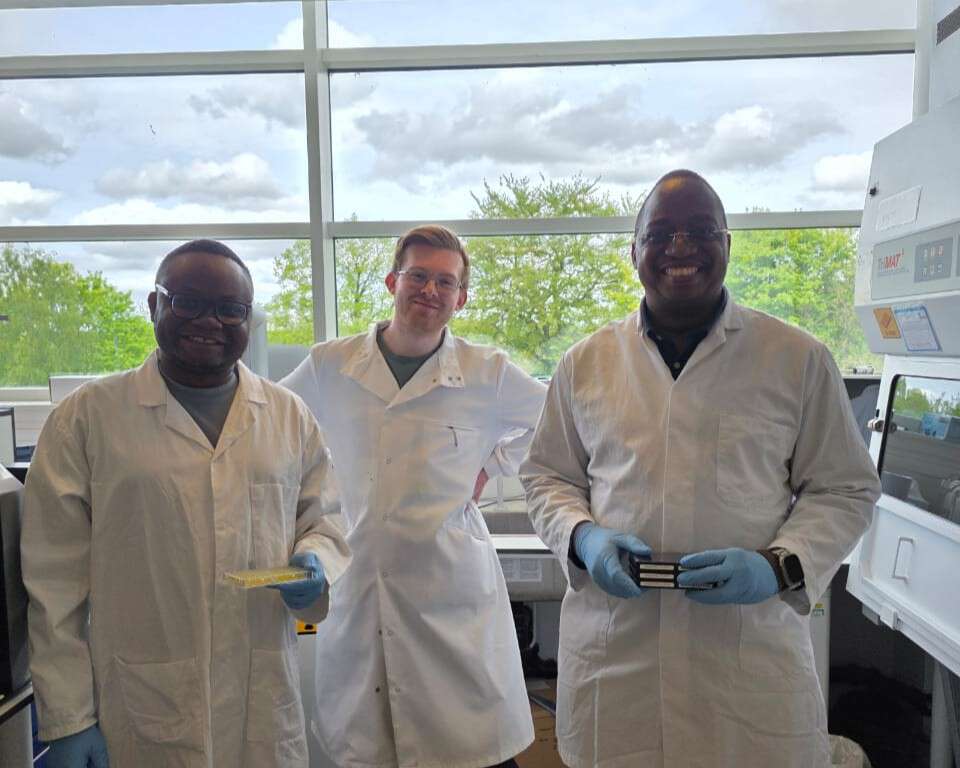
After his time at the University of Ghana where he fully immersed himself in computational work on generated genomes, Nicholas was able to identify some markers that could be protective in infected individuals if they are enhanced. This discovery, he explains, has opened a new direction for his future research that could eventually contribute to the area of therapeutics.
Across the continent Nicholas observes a significant shift: many African institutions have now developed the capacity to conduct modern genomic investigations and generate sequences and genomics data that they previously were unable to do. This progress has reduced the dependence on shipping samples to the Global North where they had the necessary technologies that were previously absent in many African countries. “The idea was just to ship samples,” he recalls. “Data is generated elsewhere. And then you lose that kind of autonomy on the data and the findings.” What is missing today, he argues, is translating basic research into something impactful that can have a tangible result like a diagnostic product or a vaccine. The problem is that many institutions do not have intellectual property policies or Technology Transfer Offices (TTOs). “Many scientists even do not know if those officers exist in the institutions where they are,” he notes.
One thing African universities can do to better respond to epidemics like mpox and Lassa fever, Nicholas reflects, is to “bridge the gap between public health initiatives like surveillance and outbreak response with research.” Secondly, he stresses the importance of supporting TTOs and initiatives that will be important to translate research into something that can have a tangible impact. “I think what African researchers can do better,” Nicholas reflects, “is to tag the public health surveillance and response teams with the researchers. They should move concurrently.” Having enough actionable data could translate into vaccines and therapeutics, and using public health data in research can better inform responses during epidemics.
Nicholas reflects that the translational aspect of research has been missing from health sciences in Africa. Introducing more translational research would increase the capacity to translate knowledge into something actionable that can reach the patients that are suffering from the epidemics. Reflecting on his own experience in Uganda, he says that when an outbreak like mpox happens, most of the diagnostics that are being used to diagnose diseases are imported from Asia. The cost implications of this are enormous, and there is also a danger of running out of testing kits. However, Nicholas argues that this is capacity that can actually be developed locally. “That is one area that would reduce that time of diagnosis and then allow for more timely interventions.”
| Meet Nicholas Dr. Nicholas Bbosa is a molecular virologist specialising in pathogen genomics, phylodynamics, molecular epidemiology and bioinformatics. He is currently an Assistant Professor of Virology at the London School of Hygiene & Tropical Medicine and a Senior Scientist at the MRC/UVRI & LSHTM Uganda Research Unit. He also leads the Virus Surveillance and Discovery project at the Uganda Virus Research Institute (UVRI), where he applies genomic and metagenomic approaches to detect, characterize and track pathogens of public health importance. Research focus: Developing an early warning system for mpox outbreaks Host institutions – University of Ghana – Supervisor: Prof. Gordon Awandare – University of Glasgow – Supervisor: Prof. Lilach Sheiner – University of Bern – Supervisor: Dr. Phaedra Simitsek |
“I feel that this training has given me sufficient exposure and the skills needed to enter into this space and to make a difference.”
With this encouraging reflection, Dr. Nicholas Bbosa, molecular virologist and pathogen genomics expert at The Medical Research Council (MRC) and Uganda Virus Research Institute (UVRI), looks ahead during the closing week of the AU-EU Health Partnership – a programme designed to strengthen research on mpox and Lassa fever.
During his mobility at the University of Glasgow, Nicholas appreciated that he had the opportunity of adding a new layer of depth to the knowledge he already had in genomics, giving him a “more informative and comprehensive understanding of dynamics of infection”. He said, “in the past, I’d come across them mostly in the area of HIV, but now being applied to mpox, which is currently one of the viruses that I’m interested in and working with, was quite refreshing.” He is eager to bring this expanded expertise back to Uganda and collaborate with fellow scientists working on similar challenges.
After his time at the University of Ghana where he fully immersed himself in computational work on generated genomes, Nicholas was able to identify some markers that could be protective in infected individuals if they are enhanced. This discovery, he explains, has opened a new direction for his future research that could eventually contribute to the area of therapeutics.
Across the continent Nicholas observes a significant shift: many African institutions have now developed the capacity to conduct modern genomic investigations and generate sequences and genomics data that they previously were unable to do. This progress has reduced the dependence on shipping samples to the Global North where they had the necessary technologies that were previously absent in many African countries. “The idea was just to ship samples,” he recalls. “Data is generated elsewhere. And then you lose that kind of autonomy on the data and the findings.” What is missing today, he argues, is translating basic research into something impactful that can have a tangible result like a diagnostic product or a vaccine. The problem is that many institutions do not have intellectual property policies or Technology Transfer Offices (TTOs). “Many scientists even do not know if those officers exist in the institutions where they are,” he notes.
One thing African universities can do to better respond to epidemics like mpox and Lassa fever, Nicholas reflects, is to “bridge the gap between public health initiatives like surveillance and outbreak response with research.” Secondly, he stresses the importance of supporting TTOs and initiatives that will be important to translate research into something that can have a tangible impact. “I think what African researchers can do better,” Nicholas reflects, “is to tag the public health surveillance and response teams with the researchers. They should move concurrently.” Having enough actionable data could translate into vaccines and therapeutics, and using public health data in research can better inform responses during epidemics.
Nicholas reflects that the translational aspect of research has been missing from health sciences in Africa. Introducing more translational research would increase the capacity to translate knowledge into something actionable that can reach the patients that are suffering from the epidemics. Reflecting on his own experience in Uganda, he says that when an outbreak like mpox happens, most of the diagnostics that are being used to diagnose diseases are imported from Asia. The cost implications of this are enormous, and there is also a danger of running out of testing kits. However, Nicholas argues that this is capacity that can actually be developed locally. “That is one area that would reduce that time of diagnosis and then allow for more timely interventions.”
| Meet Nicholas Dr. Nicholas Bbosa is a molecular virologist specialising in pathogen genomics, phylodynamics, molecular epidemiology and bioinformatics. He is currently an Assistant Professor of Virology at the London School of Hygiene & Tropical Medicine and a Senior Scientist at the MRC/UVRI & LSHTM Uganda Research Unit. He also leads the Virus Surveillance and Discovery project at the Uganda Virus Research Institute (UVRI), where he applies genomic and metagenomic approaches to detect, characterize and track pathogens of public health importance. Research focus: Developing an early warning system for mpox outbreaks Host institutions – University of Ghana – Supervisor: Prof. Gordon Awandare – University of Glasgow – Supervisor: Prof. Lilach Sheiner – University of Bern – Supervisor: Dr. Phaedra Simitsek |


