Prof. Mustapha Umar Imam

“You need to design your research in such a way that, right from the outside, you’re thinking of making an impact…”
Mustapha Umar Imam, Professor of biochemistry and Director of the Centre for Vaccine Research and Biotechnology at the Federal University of Lafia, Nigeria shares his reflections on one of the central tensions he observed during the closing week of the AU-EU Health Partnership – a programme designed to strengthen research on mpox and Lassa fever.
During his stay at Pompeu Fabra University, Mustapha was particularly inspired by the hands-on approach of his hosts where fellows and supervisors exchanged and refined their translational research project, with a feedback loop that challenged assumptions and accelerated their understanding of Lassa fever and mpox which they have studied for a long time without access to the same facilities and broader set of ideas they were exposed to in Barcelona.
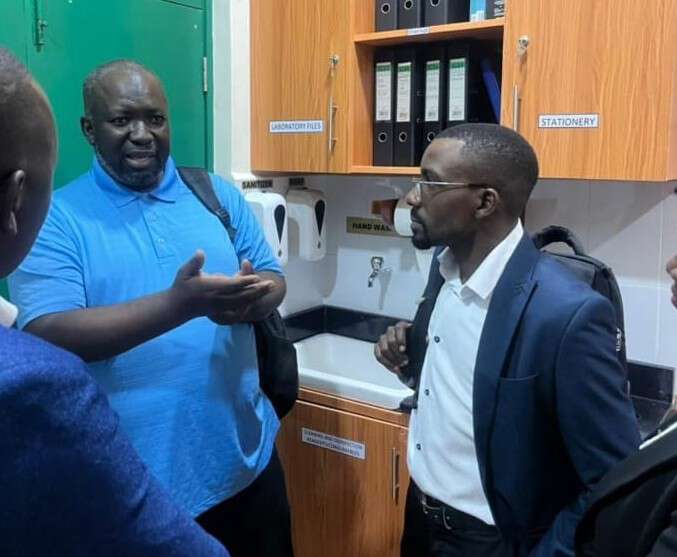
For Mustapha, this experience further fuelled his interest in Lassa fever. He even shared that he learned more about the virus during his two-week stay in Barcelona than anywhere else. It also prompted deeper reflection on how such expertise and capacity could be cultivated within Nigeria. He stressed that translational research should be strengthened not only by Africa-Europe collaboration but also by intra-Africa collaboration. Drawing from his experience, Mustapha called for African countries to build research ecosystems that can host valuable exchanges that can be creative and adapted to local realities. He is hopeful that the network he developed through the Africa-Europe Clusters of Research Excellence on this fellowship is already laying groundwork for future collaboration, from aiming to secure joint grant applications to establishing shared research pipelines.
Mustapha imagines a future where a discovery made in Nigeria could be rapidly validated by colleagues from across the continent: with the potential innovation tested and eventually taken up by pharmaceutical companies for large-scale production across different countries. Joint funding, he added, could help build the critical mass around which a regulatory ecosystem can be established to make this vision a reality.
The fellowship also reshaped his understanding on the importance of how discoveries can be translated from lab to market to ensure they have an impact within society. “You need to design your research in such a way that, right from the outside, you’re thinking of making an impact,” he reflected.
Another key lesson from the fellowship was the importance of engaging not only regulators and policymakers but also communities. “If we don’t talk to the people that matter and the regulators, for example, policymakers and even people in the community, we cannot make a discovery,” he said. He pointed to the persistent challenge of vaccine hesitancy in Africa. Even when vaccines are free, people often refuse them because they feel disconnected from the research process or distrust the institutions behind it. “With enough funding, universities will be able to expand, do more in terms of disease response, and study diseases that are endemic to Africa, such as Lassa fever”.
| Meet Mustapha Prof. Mustapha Umar Imam, Professor of biochemistry and Director of the Centre for Vaccine Research and Biotechnology at the Federal University of Lafia, Nigeria Professor Imam is a molecular biotechnologist and translational vaccine researcher. His work focuses on translating molecular discoveries into practical health interventions relevant to Africa, including vaccine development, diagnostic tools, and preventive strategies for chronic and infectious diseases. He holds an MBBS from Bayero University Kano and a PhD in Molecular Biotechnology from Universiti Putra Malaysia. Research focus: Developing a preventative mRNA vaccine candidate for Lassa fever Host institutions – Makerere University – Supervisor: Prof. Damalie Nakanjako – Radboud University – Supervisors: Prof. Benjamin Mordmüller, Prof. Marien De Jonge & Prof. Quirijn de Mast – Pompeu Fabra University – Supervisor: Prof. Andreas Meyerhans – University of Bern – Supervisor: Prof. Carmen Faso |
“You need to design your research in such a way that, right from the outside, you’re thinking of making an impact…”
Mustapha Umar Imam, Professor of biochemistry and Director of the Centre for Vaccine Research and Biotechnology at the Federal University of Lafia, Nigeria shares his reflections on one of the central tensions he observed during the closing week of the AU-EU Health Partnership – a programme designed to strengthen research on mpox and Lassa fever.
During his stay at Pompeu Fabra University, Mustapha was particularly inspired by the hands-on approach of his hosts where fellows and supervisors exchanged and refined their translational research project, with a feedback loop that challenged assumptions and accelerated their understanding of Lassa fever and mpox which they have studied for a long time without access to the same facilities and broader set of ideas they were exposed to in Barcelona.
For Mustapha, this experience further fuelled his interest in Lassa fever. He even shared that he learned more about the virus during his two-week stay in Barcelona than anywhere else. It also prompted deeper reflection on how such expertise and capacity could be cultivated within Nigeria. He stressed that translational research should be strengthened not only by Africa-Europe collaboration but also by intra-Africa collaboration. Drawing from his experience, Mustapha called for African countries to build research ecosystems that can host valuable exchanges that can be creative and adapted to local realities. He is hopeful that the network he developed through the Africa-Europe Clusters of Research Excellence on this fellowship is already laying groundwork for future collaboration, from aiming to secure joint grant applications to establishing shared research pipelines.
Mustapha imagines a future where a discovery made in Nigeria could be rapidly validated by colleagues from across the continent: with the potential innovation tested and eventually taken up by pharmaceutical companies for large-scale production across different countries. Joint funding, he added, could help build the critical mass around which a regulatory ecosystem can be established to make this vision a reality.
The fellowship also reshaped his understanding on the importance of how discoveries can be translated from lab to market to ensure they have an impact within society. “You need to design your research in such a way that, right from the outside, you’re thinking of making an impact,” he reflected.
Another key lesson from the fellowship was the importance of engaging not only regulators and policymakers but also communities. “If we don’t talk to the people that matter and the regulators, for example, policymakers and even people in the community, we cannot make a discovery,” he said. He pointed to the persistent challenge of vaccine hesitancy in Africa. Even when vaccines are free, people often refuse them because they feel disconnected from the research process or distrust the institutions behind it. “With enough funding, universities will be able to expand, do more in terms of disease response, and study diseases that are endemic to Africa, such as Lassa fever”.
| Meet Mustapha Prof. Mustapha Umar Imam, Professor of biochemistry and Director of the Centre for Vaccine Research and Biotechnology at the Federal University of Lafia, Nigeria Professor Imam is a molecular biotechnologist and translational vaccine researcher. His work focuses on translating molecular discoveries into practical health interventions relevant to Africa, including vaccine development, diagnostic tools, and preventive strategies for chronic and infectious diseases. He holds an MBBS from Bayero University Kano and a PhD in Molecular Biotechnology from Universiti Putra Malaysia. Research focus: Developing a preventative mRNA vaccine candidate for Lassa fever Host institutions – Makerere University – Supervisor: Prof. Damalie Nakanjako – Radboud University – Supervisors: Prof. Benjamin Mordmüller, Prof. Marien De Jonge & Prof. Quirijn de Mast – Pompeu Fabra University – Supervisor: Prof. Andreas Meyerhans – University of Bern – Supervisor: Prof. Carmen Faso |


